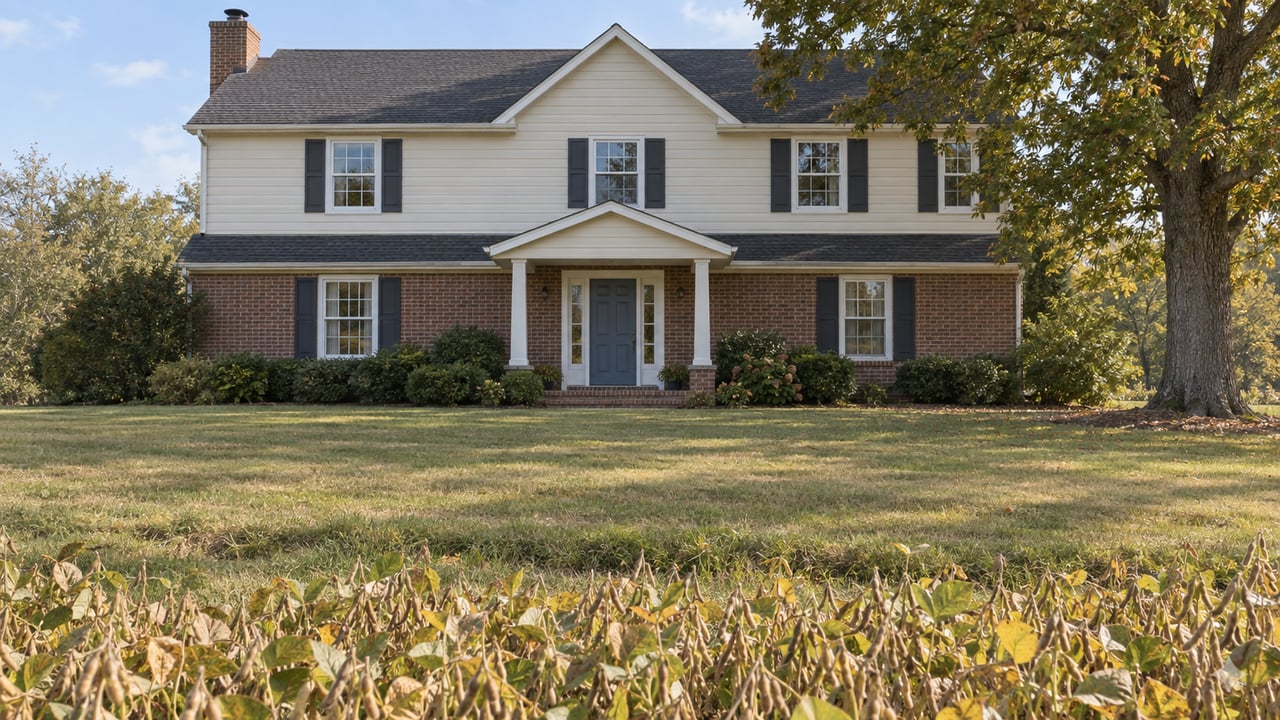
The purchase price on a ten-acre parcel outside Prospect or LaRue tells you what the land costs today. It does not tell you what the county might bill you for tomorrow, once the tractors stop and the framing starts.
That second number comes from a program most buyers have never heard of until it shows up on a tax bill: Current Agricultural Use Valuation, or CAUV. Marion County has plenty of it, because Marion County has plenty of farmland sitting exactly where growing families want to build. The land looks like an open lot. On the auditor's books, it's something else, and converting it triggers a bill that has nothing to do with your mortgage.
What CAUV Actually Protects
Ohio voters approved a constitutional amendment in 1972 that let farmland be taxed at its agricultural value instead of its market value. The idea was straightforward: a farmer working active cropland shouldn't pay property tax as if the field were already a subdivision. The Marion County Auditor's CAUV page lays out the mechanics, and the state's own guidance confirms the discount is real. Qualifying farmland can see its taxable value cut by 30 to 80 percent compared to a standard market-value assessment, with the biggest gaps showing up on land at the edge of a growing town, exactly where market pressure is highest and agricultural income is lowest relative to what a builder would pay.
Here's the part buyers miss. CAUV never touches the house, the homesite, or any outbuildings on the parcel. Those are valued at market rate no matter what. CAUV only discounts the surrounding acreage still in active production. So a ten-acre lot with a farmhouse and eight tillable acres has two different tax stories running side by side on the same parcel number.
The Moment It Flips
CAUV isn't a one-time election. A landowner has to refile every year, and the county performs annual field inspections to confirm the ground is still doing what the application says it's doing. Miss the renewal window, which closes the first Monday in March, or stop farming the acreage, and the auditor is required by state law to pull the property out of the program and value it at current market rate instead.
That alone would just mean a bigger bill going forward. The part that catches buyers off guard is what happens to the years already behind you. The Marion County Auditor's FAQ states it directly: when land loses CAUV status, the auditor is required "to recoup the taxes for the current tax year and for two years in the past." That's three years of the tax savings the land had been receiving, assessed all at once, added straight to the tax bill. It isn't a penalty in the sense of a fine. It's the state clawing back a discount that was only ever conditional on the land staying in agriculture.
Buy a farm field, break ground on a house pad, and you've converted the use. If the parcel was enrolled in CAUV when you bought it, that conversion is very often the trigger.
Why This Lands Differently in Marion County
A lot of Central Ohio counties have some CAUV acreage. Marion County has it wrapped around nearly every incorporated place in the county, because the tax base outside the city itself is still overwhelmingly agricultural. That's exactly the geography a family looking for five acres and elbow room tends to search first, and it's exactly the geography where a builder or an owner-occupant buyer is most likely to be closing on a parcel with an active CAUV enrollment attached.
It compounds with a second fact about the county that has nothing to do with taxes. Marion Public Health notes plainly that much of Marion County is unsewered, and individual home sewage systems are required in order to build on most rural parcels. So the same buyer working through a CAUV conversion is also working through a septic site evaluation, a permit to install, and a scheduled inspection before the system can be covered. Neither process shows up on a listing sheet. Both have to be resolved, on separate government timelines, before the house you're picturing can legally go up.
The County Just Reset Its Numbers
This isn't background trivia this year. Marion County went through its full six-year property reappraisal for tax year 2025, with the new values calculated at the end of December 2025 and reflected in the bills landing in 2026, the ones property owners are looking at right now. The county's own revaluation portal confirms the last full revaluation before this one was 2019, with a mid-cycle update in 2022, meaning 2025 was the county's turn again.
CAUV soil values move on their own three-year clock set by the state, and that clock lines up with reappraisal years. The Ohio Farm Bureau has flagged that agricultural soil values are trending upward again in many of the counties on this cycle, after years of being pinned near historic lows. Put those two resets together and the gap between what a Marion County parcel is worth as farmland and what it's worth as a homesite, the exact gap that recoupment is calculated from, is running on freshly updated numbers, not last year's estimate or a neighbor's experience from a few closings ago.
That means anyone budgeting for a rural build in Marion County right now is working with a number that didn't exist a year ago. The reappraisal already happened. The math it feeds into hasn't caught up in most buyers' heads yet.
What to Put in Writing Before You Close
None of this is a reason to avoid rural land in Marion County. It's a reason to ask a short list of questions before you sign anything:
- Is the parcel, or any portion of it, currently enrolled in CAUV, and what does the county's assessed agricultural value look like next to its market value?
- If conversion happens, who is responsible for the recoupment bill: the seller who benefited from the tax savings, or the buyer who is changing the use?
- Has a septic site evaluation been done through Marion Public Health, and does the soil on the intended building envelope actually support the system size you'll need?
- If the land is being split off a larger parcel, has that split been reviewed by Marion County Regional Planning, since lot splits under five acres carry their own review process?
A purchase agreement can address the recoupment question directly, in writing, the same way it would address who pays for a well test or a radon mitigation system. Leaving it unaddressed doesn't make the liability go away. It just means the county sends the bill to whoever owns the parcel when the conversion is recorded, which by then is you.
This isn't tax or legal advice, and the actual dollar figure on any given parcel depends on its specific CAUV enrollment history and current soil valuation, which only the Marion County Auditor's office can confirm. A conversation with the auditor's office and a real estate attorney before closing costs nothing compared to what a surprise recoupment bill costs after.
FAQ
Does every rural land purchase in Marion County trigger recoupment? No. Only parcels currently enrolled in CAUV are exposed, and only if the use actually changes or the annual renewal lapses. Land that was never enrolled, or land where the ag acreage stays in production while a house goes up on an already-valued homesite, doesn't trigger it the same way.
Can a seller agree to cover the recoupment bill instead of the buyer? Yes, that's a negotiable term. It has to be spelled out in the purchase agreement, since Ohio law directs the recoupment charge to whoever holds title when the county records the conversion, not automatically to the party who benefited from the original tax savings.
How is the recoupment amount actually calculated? It's the difference between what was paid under the agricultural valuation and what would have been paid at market value, for the current tax year and the two years before it. The exact figure depends on the parcel's specific CAUV soil values and its market assessment, both of which the county auditor's office can pull for a specific property.
If you're looking at acreage in Marion County and want to know what's actually enrolled, what's already been converted, and what a purchase agreement should say about it before you sign, MORE Ohio Team walks that ground with clients every week. Reach out before you write the offer, not after the auditor's letter arrives.