The building has changed jobs before. It was a restaurant once. Later it was a pawn shop. This week it became something downtown Marion has never actually had, and the strange part is that nobody involved can tell you exactly what it's for yet.
That's not an oversight. It's the point.
The Address Everybody Walked Past
If you've lived in Marion for more than a few years, you've probably walked by 146 North Main Street a dozen times without registering it. It's a small storefront on a stretch of downtown that has quietly filled back in with businesses over the past several years. Downtown Marion Inc., the nonprofit that has spent years working to bring the district back, counts 42 new businesses across retail, restaurants, education, and professional services since 2018. That's the number people cite when they talk about downtown's comeback, and it's a real one.
But the newest tenant at 146 North Main isn't a business at all. It's Ohio State Marion's new Downtown Engagement Hub, and Dean and Director Jennifer Schlueter described the building's résumé plainly in an interview with WOSU: "It's a little building that has a long history in this town. It was a restaurant, it was a pawn shop, it's been a lot of different things, and now it's going to be Ohio State Marion's home in the downtown."
That history matters, because it's a compressed version of downtown Marion's own arc. A building that once needed a pawn shop to stay occupied is now the address a state university chose for its most visible bet on the district.
What It Isn't
Here's the thing that separates this from a typical "university opens satellite office" story. When asked directly whether the hub was meant to create jobs downtown, Schlueter didn't hedge.
"Its core purpose is not about bringing more jobs to downtown. It's a place that's going to be a kind of collaboration zone and a space that we're going to host, co-design and collaborative conversations to leverage everything that Ohio State knows and does in the service of this wonderful city that hosts Ohio State Marion."
That's an unusual thing for an institution to say out loud about a new building. Most downtown openings come with a jobs number or a square-footage brag. This one comes with an explicit disclaimer that jobs aren't the metric.
It's also not trying to duplicate what's already there, and the university has been specific about that. Marion already has The Forge, which teaches people how to start a business, a block away at Marion Tech Downtown. It has Connect Coworx as its coworking space. The Marion Area Chamber of Commerce already convenes the business community, and Aerophlix Studios already supports local creatives. On the service side, the Marion CommUNITY Collaborative, run through Aspire Ministries, already coalesces local service agencies, and Black Organizations of Marion already brings advocacy groups together to work in coordination.
So if downtown Marion already has a business incubator, a coworking space, a chamber, a creative studio, and two organizations built for cross-agency coordination, what exactly does a sixth entity add?
The Room Built to Have No Fixed Job
The answer, based on how Ohio State Marion is describing it, is that the hub isn't meant to add a seventh category of service. It's meant to be the room where the other six can sit down together on a specific problem and actually work on it, rather than each running their own separate calendar.
Schlueter was candid about what those problems look like right now. Marion, she said, is "a legacy city, which means, you know, it had a strong manufacturing history and then underwent significant change and challenge and transformation." She pointed to two live pressure points: how the city continues reinventing itself around new industries and workforce demands, and the needs around addiction and behavioral health that tend to accompany a city working through that kind of transformation.
Those aren't abstract talking points for a ribbon-cutting. They're the actual agenda items the hub is being built to host, alongside what Schlueter also called out unprompted: the joy, the stories, the things in Marion worth archiving and celebrating that don't fit neatly into an economic development slide deck.
The building has no locked-in daily function. A workshop might happen there on a Tuesday. A gallery show might take over the same room on Thursday. The programming is built substantially from what the community proposes to the university, not the other way around. That's an unusual amount of blank space for an institution to build into a physical location on purpose.
Why the Chairs Matter
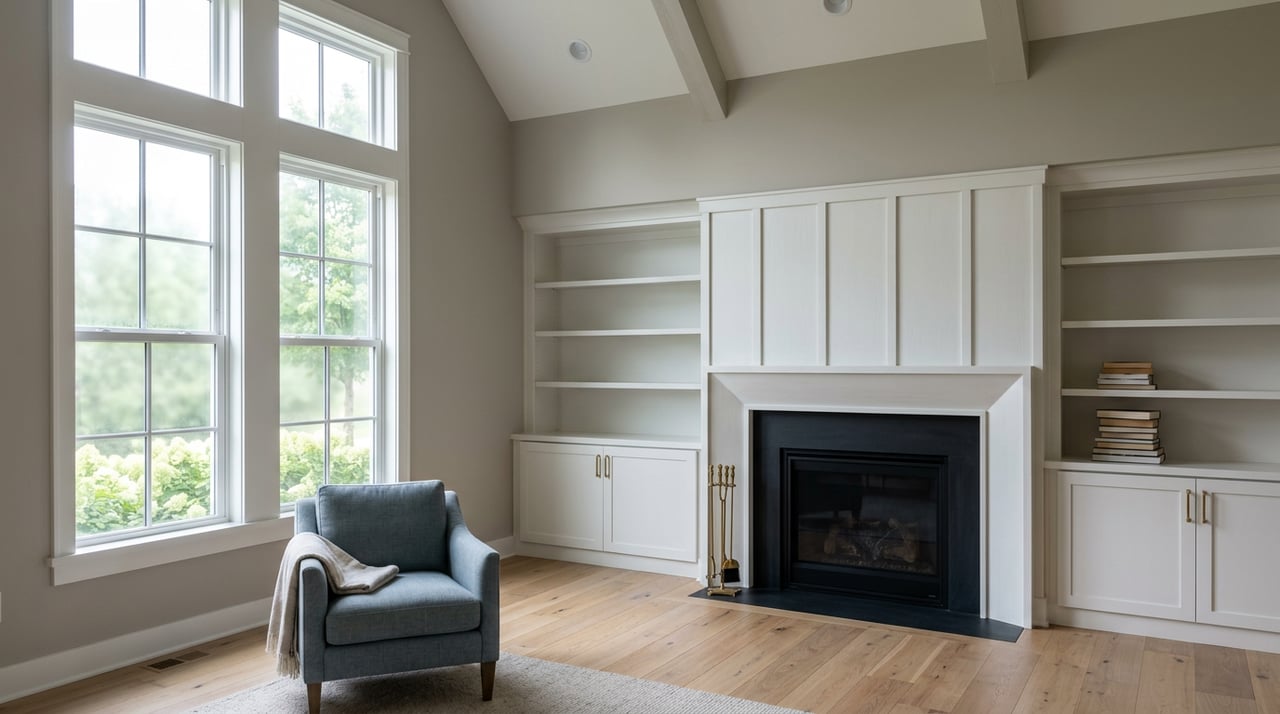
The interior design tells the same story in a quieter register. The space was designed by Rebekah Matheny, an Associate Professor of Interior Design in Ohio State's Department of Design, who also designed the Keenan Center in Columbus. Her approach works on what amounts to a sensory level: materials, light, texture, the way a room tells you how to feel before you've consciously decided anything.
The result, by design, has to do several contradictory things at once. It has to be flexible enough for a workshop one day and a gallery the next. It has to be comfortable, because people don't think well in bad chairs. It has to read clearly from the sidewalk as a place doing something, not an empty storefront. And it has to look unmistakably like a working space, somewhere things get made, moved, marked up, and figured out, rather than a lobby or a lecture hall.
That's a lot of design intention for a building that, by the university's own description, doesn't have one job. It's the kind of investment you make when you expect the room to get used constantly and unpredictably, not occasionally and by appointment.
What This Actually Looks Like If You Live Here
For a Marion resident, the practical version of all this is simple. The hub sits at 146 North Main Street and keeps posted hours Wednesday through Friday, 10 a.m. to 5 p.m., though its actual programming often falls outside those hours, which is why the university is steering people toward its calendar rather than a fixed schedule. Leslie Beyer-Hermsen, Assistant Dean at Ohio State Marion, is the named point of contact for the space.
You don't need a connection to Ohio State to walk in with something. Based on how the university has framed it, the kinds of things worth bringing are a challenge your organization is stuck on, a project you want to test with real people, a partnership idea with campus faculty or students, or an event idea that would make downtown a better place to be on a Saturday. That last one is deliberately broad. The Hub is explicitly not trying to compete with what The Forge, Connect Coworx, or the Chamber already do well. It's trying to be the room where those groups, and residents who don't belong to any of them, can sit at the same table.
The Quiet Version of a Downtown Comeback
Downtown Marion's revival has mostly been told through the loud version: the Popcorn Festival that drew its usual enormous crowd earlier this month, the Marion Palace Theatre's ongoing run of shows in a building that's hosted audiences since 1928, the Cardinal Project's painted birds scattered through downtown storefronts. Those are the events that make downtown feel like a destination for a weekend.
The Downtown Engagement Hub is the opposite kind of signal. It's not designed to draw a crowd once a year. It's designed to sit on North Main Street, most days, as a bet that the harder, slower work of a legacy city rebuilding itself, the workforce questions, the behavioral health questions, the just-plain-figuring-it-out questions, goes better when it happens downtown instead of on a campus a few miles away. A university choosing to locate that work inside a storefront it doesn't fully control, next door to businesses it didn't start, is a different kind of commitment than opening another program with its own name on the door.
That's the part worth knowing if you live in Marion and have driven past 146 North Main Street without a second look. The building has already been a restaurant and a pawn shop. What moved in this week isn't trying to be the next thing on that list. It's trying to be the place where the next thing gets decided.
If you're watching what's happening in downtown Marion because you're curious about where the city is headed, or because you're thinking about what that means for a street a few blocks over, MORE Ohio tracks this market block by block. Work With Us when you're ready to talk about what it means for your own address.